“If I was an imitation, a perfect imitation, how would you know if it was really me?”
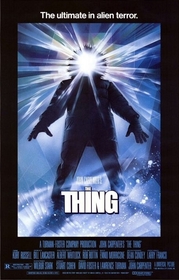
The Thing is horror master John Carpenter’s remake of the 1951 film The Thing from Another World, which stars James Arness as a Frankenstein-esque alien menacing a scientific expedition. While The Thing from Another World is an undisputed horror classic, Carpenter did not want to merely repeat its shocks. He decided to go back to the original short story by John W. Campbell Jr., entitled “Who Goes There?” Consequently, The Thing follows this source material much more closely than the 1951 film. No longer a tale of a monster attacking from the outside, it is now a story of a threat coming from within, not without. Instead of “Keep watching the skies” (the last line from The Thing from Another World), the tagline for this film could be “Keep watching the guy next to you.” What John Carpenter has created is a magnificent tale of fear of paranoia, without even the comfort of knowing that the threat “is out there.” In The Thing, the danger is among us.
The Thing introduces us to the twelve members of an isolated US Outpost in the Antarctic, which has been invaded by an ancient alien being. However, unlike the easily recognizable creatures of yore, this alien can perfectly copies any life form it encounters, blending in perfectly with its surroundings. Not even the audience is always aware of who the alien and who isn't... Paranoia soon grips the camp and it is up to R.J. MacReady (Kurt Russell) to discover the alien's true identity and protect the future of mankind.
Arguably, the most memorable aspect of The Thing is the special effects wizardry of Rob Bottin, who presents us with one of the most dazzling and shocking monsters in screen history. Bottin (whose credits include The Howling and Fight Club) offers us an alien that has no true form of its own. We don’t even have the comfort of at least knowing what the creature looks like; we only ever see it in some misshapen state between hosts. A true “thing” that is made up of ever-changing parts of bodies, combinations of species (once you have seen it, it is a safe bet that you’ll never forget the head with spider’s legs), and unearthly screeches, Bottin creates a monster that is ever-changing, horrifying, and, most importantly, completely believable.
These astonishing effects compliment characters that are down-to-earth and credible. We never learn much about the characters; instead, they are nothing more than archetypes. Kurt Russell plays the laconic hero, Wilford Brimley the wise man, and Keith David the no-nonsense tough guy. We learn their last names and their jobs at the base, but not much more - certainly nothing about their backgrounds or their personal lives. While this lack of depth might appear to be a weakness, it is actually one of The Thing’s strengths. Because we are already familiar with the straightforward hero, or the wise old curmudgeon, we mentally fill in the characters’ backgrounds ourselves. This allows us to jump into the story with as little dull exposition as possible, and also provides us with an instantly familiar spectrum of characters with which we can readily identify.
The Thing's outstanding cast fleshes out these rather thin characters, and gives us a vivid presentation of terrified and believable people. Each one of the actors brings to life people who are paranoid and horrified. Their reactions to the bizarre and terrifying situation they find themselves in are so believable that you might almost think you are watching a documentary. The actors bring us to a place where every look has two meanings, where the most innocent phrase may have a sinister interpretation, and where a brief absence can be the difference between human and alien.
Nearly all the actors in this film give pitch perfect performances. Keith David’s portrayal of Childs, one of the camp’s natural leaders, is a wonderful example. Throughout the whole film he gives off a “Mr. Cool” vibe, always trying to be the person who has everything in order. Even as events seem bleaker, he keeps acting more and more in control. Nevertheless, his braggadocio covers a great deal of fear. In the blood test scene, when Palmer (David Clennon) starts changing before their eyes, Childs begins kicking and screaming in fear, showing us just how scared he really is. Thomas G. Waites gives an equally outstanding performance, portraying Windows, the communications officer, as a scared man desperately trying to cling to someone. Throughout most of the film, he seems almost in tears, and at one point even smashes through a window to get to a shotgun. Constantly looking around with his jaw always dropped, eyes darting about from person to person, Waites's character is always desperately looking for some reassurance. About the only one of this stellar cast that does not give an outstanding performance is Wilford Brimley, who plays the doctor, Blair. He plays his character too over the top, particularly in the scene where he is destroying the communications center. When he screams “Nobody is getting out of here… nobody,” or later when he yells at Childs “I’ll kill you,” he is so overwrought that it provokes laugher rather than fright. Nevertheless, despite this one disappointing performance, the members of the cast bring a chilling reality to this fantastic and horrifying film.
Carpenter’s direction is masterful. As in his classic Halloween, Carpenter uses the corners of the frame to great advantage. During one particularly tense scene, Clark (Richard Masur), the dog keeper, can be seen quietly picking up a scalpel and preparing to attack MacReady. Just barely in camera, on the far left side, only we in the audience see it; the rest of the characters do not. However, instead of reassuring us of MacReady's humanness when he shoots Clark in the head, Carpenter's use of the camera only makes us more paranoid. In another breathtaking scene, a character’s belly opens up with shark-size fangs, and bites off the doctor’s arms. MacReady sprays a flamethrower at the assimilated man (the only way to truly kill the “thing”) but doesn’t notice that the man’s head has ripped off his own body, sprouted spiders legs, and started to crawl away. Carpenter shows us this in a tight close-up of MacReady, while the head slinks off to the left. It is only when Palmer looks back and says “You gotta be f**kin’ kidding” that MacReady notices and takes action.
A dark film, The Thing is shot mostly in dimly lit corridors and rooms; many of the outdoor scenes, particularly near the end, are at night. Most of the time, the base feels like a darkened maze, where anything can come from anywhere at anytime. The camera slowly prowls through the corridors, just as one of the frightened characters might do, suggesting isolation and despair. Even the well-lit outdoor scenes are oppressive. All one can see is a never-ending white landscape. The sense of isolation is palpable, making the film even more frightening. There is no possibility of help. We are on our own here, and we cannot tell our friends from our enemies.
Carpenter also uses his direction to quickly strip away all of the veneer of civilization from his characters, exposing the fear and paranoia beneath. One of the techniques he uses is to add small, unobtrusive imagery that contributes a constant state of unease the film. We see a noose hanging in Blair’s shack, a blanket starts to move when Windows’s back is turned, and the assimilated Blair’s fingers under the skin of Garry's (Donald Moffat) face. These small details make sure that we stay uncomfortable between the loud, monstrous outbursts. It doesn’t matter if we’re seeing a quiet discussion between two characters, or if we’re watching the Things violently assimilate someone. We are never allowed a moment of relief, leaving us almost as haggard as the characters. Carpenter never tips us as to who is human and who is not. Even the scientists that are assimilated act as if they were human; there are no strange looks or mysterious phrases from the assimilated characters. No one, not even the audience, knows who can be trusted, and who can’t.
Probably the best scene in The Thing is the tension filled, sweat-dripping blood test sequence. By this time MacReady has figured out that every part of the alien is an autonomous entity. Tying up all the remaining characters to a couch, he takes a sample of their blood, and then applies a hot wire to each sample to see if it reacts. One by one, we see each man tested. Clips of MacReady testing the blood cut away to close-ups of each person’s face. Carpenter skillfully misleads us, by having the conversation debate over all the rivalries and suspicions that have been circulating among the men. We listen this paranoid debate over who might be the Thing, when Palmer’s blood finally reacts (the blood screeches loudly and jumps out of the sample container). This reaction comes as a shock, we having been so caught up in the intricacies of the discussion.
The Thing is definitely one of the most intense and horrific films ever made. Outstanding special effects, superb casting, and brilliant direction all combine to create an unmatched tale of paranoia and terror. From its opening moment to its conclusion, The Thing forces us to experience the horror and suspicion of its characters in a way that few other films can. It imparts a sense of genuine and inevitable dread. While from a historical perspective, Halloween is unquestionably more significant, I believe that The Thing is John Carpenter’s masterpiece.
Trivia:
Screenwriter Bill Lancaster is the son of actor Burt Lancaster.









I saw this film in Los
I saw this film in Los Angeles the first week it was released. I remember a line in this film that made reference to the Glomar Explorer and Hughes Aircraft. Since I worked for Hughes at the time, this line stood out. However, in subsequent viewings over the years, I have not heard this line.
Do you know anything about this? Could the line have been edited out for some reason, e.g. litigation threat from Hughes? National Security issues?
A few nights ago, me and my
A few nights ago, me and my dad popped THE THING into the DVD player. Having read rave reviews of the film, and being a rabid fan of John Carpenter's HALLOWEEN, I had high hopes, half-expecting this film to knock HALLOWEEN out of the park. But I was wrong.
THE THING is a vastly overrated film. I can't quite figure out why it has such a strong following, although it may be its unrelenting gore. Although gore is not bad, some films substitute suspense and character develoipment, which is exactly what THE THING does. We learn very little about Kurt Russell + Co. , much less get their names straight, which gives us little reason to care about them. They are just run of the mill archetypes. Archetypes like Laurie Strode (girl next door) and Dr. Loomis (monster hunter) worked well in HALLOWEEN because they were well performed roles with good dialogue. The characters in THE THING get little dialogue besides boring technical talk and profanity filled exclamations and none of the performances are very good. (Heck, only one character seems at all susprised to find a 10,000 year old alien. Talk about realistic!!)
Perhaps this wouldn't matter as much if there was actual suspense in the film. But there isn't. Just alien guts. (Speaking of aliens, doesn't this film's plot seem a little too similar to a famous Sigourney Weaver sci-fi outing?) And as much as Mr. Carpenter wants us to believe otherwise, gore isn't scary, its just disgusting, unless we have someone to care about.
Yeah, well I'm going to have
Yeah, well I'm going to have to go ahead and totally disagree with you. In fact based on your comments and criticisms I'm surprised that you even watched the movie. Sounds to me like you would be more comfortable with "Home Alone 2" or something equally banal. "The Thing" is a monster movie. In my opinion, John Carpenter brilliantly depicted an alien creature that could absorb and become any living creature it encounters. Not only that but it can become anything that it has encountered throughout the galaxy. Rob Bottin's creation of the monster is nothing short of genius. Perhaps the best vision of a monster ever put on the screen. It is a slimy, visceral, gory
process of absorbing another organism and that is what Carpenter shows us. I like the fact that very little is left to the imagination when it comes to the monster itself. Too often we are shown only the claws slashing forward or the eyes glowing in the dark and we are to fill in the rest with our own vision of what the creature really looks like. Not this time. John Carpenter not only opens the door but takes us inside and what we see is horrific. The true stuff of nightmares. Interesting when you think about the original "Thing From Another World" which by technical necessity had to be obtuse and keep everything in the shadows. The suspense comes in the form of the prevailing sense of paranoia that increases as the characters realize that they really don't know who or what is sitting next to them. Remember that the original movie and the short story that it was based on were the product of "Cold War" paranoia where anyone could be a communist. They looked and acted like regular people but inside they were vicious monsters bent on our destruction. In that respect this movie is more closely related to "Invasion of the Body Snatchers" than "Alien". Have you even seen "Alien"? There is no comparison whatsoever. Anyway, not trying to poke at you with a sharp stick, just feel the need to defend what I think is one of the best horror movies ever made and certainly the best monster.
I agree with you it is the
You stupid little person. The
You stupid little person. The Thing isn't overrated it's a classic that has stood the test of time, your comments are beneath contempt you brainless arsehole.
I don't scare easy but this
I don't scare easy but this one had me climbing the walls. The special effects were just incredible, the music is downright eerie, the setting perfect and Carpenter's masterful direction all combine to make this is a horror classic. I won't disagree that the characters are (more or less) cliches but all the acting is so good you can overlook that. Also suggesting that "The Thing" ripped off "Alien" is just ridiculous. "The Thing" is based on a story written in the 1950s AND it takes place on Earth and not outer space. You're really grasping at straws when you make assumptions like that.
Saw this movie in the cinema
Saw this movie in the cinema on its first release and loved it. Truely scarey monster that was not just a bloke in a suit, and chock full of action.
Also in my opinion of the the best delivered lines with the word "Fuck" in it. When the head sprouted those legs, I felt everyone in the cinema thinking the same way as Palmer in the way he looked and said "You Gotta be fuckin kidding".
Seen it a few time in between on tele and video whilst doing other things pottering around the house, but saw it on dvd a few nights ago and just watched it totally without distractions and it had the same effect as it did when i first saw it.
Definately one of my all time favourites that, like Alien, has truely stood the test of time. Even the old chess machine didn't distract from the freshness as it gave me the impression of Mcready's favourite toy (Hey, he even shared a drink with it, lol. Nice one Uncle John.
Ok, here's my two cents.
Ok, here's my two cents. First of all, along with the "Alien" movies, this is one of my favorite scary movies ever. I first saw it when I was about 3 or 4 years old, and needless to say, it stuck in my little head for a bit after that. That was one hell of a monster that I had under MY bed! I still love this movie, even thou I am 31 now, and I love the genious behind the concept of this monster. Think about it: It can imitate anything, even other aliens, so if you take all the other alien and scary movies you have ever seen and then consider The Thing monster, you will realize that The Thing is a really bad sonofB. That thing has the ability to imitate even your worst nightmare (as long as it's organic..). Hell yeah.
As for a previous post on this board stating that The Thing is not all it's cracked up to be, I have to say that everyone is entitled to their own opinion. But, I have to think, if The Thing were real and that person was to encounter the likes of it, would they laugh at it? I hardly think so. I also think this person should go back and watch Alien again, then the Thing again. Then repost what both movies are REALLY about, instead of saying they are the same, which is like calling a nickle a quarter.
Saw it in the cinema on its
Saw it in the cinema on its release and frankly had never seen effects like that in cinema before. Saw it again recently on TV in HD and it still looks fantastic. I agree this is Carpenter's masterpiece and one of the greatest horror/SF films ever made. I've always wondered what the original life-form looked like!? Sadly the remake added very little to the kudos of Carpenter's version.
Anyway, here's to Godzilla 2014...