There's something to admire about film
makers that attempt something grand. John Carpenter, master craftsman
behind The Thing and Halloween, would seem an ideal choice to create
a film that treats God and the Anti-Christ with a scientific eye in
the midst of a slow boil supernatural and intellectual horror
thriller. What evolves out of this effort is something that is
partially scientific and partially a horror film, but these parts do
not gel together into a satisfying end product.
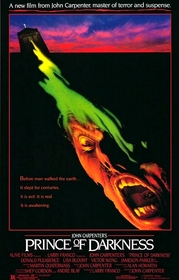
Prince of Darkness details the efforts of a
Catholic priest (Donald Pleasence) and a professor (Victor Wong),
along with a smattering of post-grad students, to analyze a
mysterious canister of liquid in a church. In true John Carpenter
tradition, they all end up besieged by an army of possessed homeless
people (led by Alice Cooper, of all people), the heroes become bodily
and mentally corrupted from within, dropping one by one, and it all
ends with an ambiguous flourish of 'maybe it isn't over!'.
John Carpenter's greatest films
specialize in strongly delivering simple concepts. Prince of Darkness
instead attempts to bring us evil in the terms of quantum physics. In
its simplest terms, the movie is about the evil liquid Anti-Christ
trying to take solid form so it can haul Satan into our world. But
the way the film discusses the whole situation is never simple. We're
given discussions of matter and anti-matter, and then told to apply
these concepts to Christian theology, posing Satan not as an
embodiment of evil, but actually the 'Anti-God'. The film goes even
further, throwing out ideas such as Jesus being an alien. While
there's potential behind exploring that idea, the film just doesn't
spend enough time building up that mythology. It just throws out
these ideas, alien Jesus and Anti-Gods, and fails to develop them to
a satisfactory depth. It's disappointing specifically because these
ideas have such great potential. We are let down not by the fact that
the ideas are absurd, but that they are so shallowly presented. A
scientific approach deserves depth and explanation, not simply labels
and short statements.
This paper-thin mythology leads to a
major problem of suspension of disbelief, which isn't helped by the
mostly wooden acting of the cast. Even Misters Pleasence and Wong
seem to barely be able to get through their lines with an ounce of
feeling. The other actors struggle even more, seemingly unable to
comprehend any more about the script than the audience. Worst of all,
because their performances are stilted and wooden, the characters are
utterly unsympathetic. Even Alice Cooper, who has always made a
living off of being creepy, doesn't fit into the film. His failings
are not in his performance, but in the fact that you go 'wait, that's
Alice Cooper' whenever he's on screen. It takes you out of the
action, out of the world constructed and it becomes more and more
difficult to become empathetic with the characters and events.
The film does work, when it goes for
the more tangible horror. The sequence where a woman crawls on top of
another in bed, then proceed to vomit evil slime into her mouth, is
disgusting and horrifying by its basic, visceral nature. When Calder
bangs a chair up the stairs behind himself, singing Amazing Grace
before he slits his own throat, it is the most harrowing moment of
the film. The sheer amount of crawling bugs and other grisly elements
also contribute to a sense of creepiness that does pervade a lot of
the overall mood of the film. This mood only fails when its
exposition falters and ruins the suspension of disbelief, as I said
before.
If there's one moment that sticks out
in my mind as the biggest failing of Prince of Darkness, it's the
'creepy possessed lady types messages from evil' scene. The horror is
supposed to come from the idea of this seemingly catatonic woman, her
fingers furiously typing at a computer keyboard, repeating the words
'I Live!' over and over. When observed, suddenly she starts typing
different messages, attempting to strike fear into the hearts of
these poor grad students (and the audience). "You will not be saved
by the Holy Ghost. You will not be saved by the god Plutonium. In
fact, YOU WILL NOT BE SAVED." The first two lines are perfectly
acceptable. It's the third line that just makes the whole thing fall
down. The 'In fact' makes the evil sound like an egomaniacal comic
book villain. 'In fact', this makes the Anti-Christ sound like an
uptight dweeb, not some overwhelming evil from before the dawn of
man. Again, a factor that ruins the suspension of disbelief and draws
you out of the film instead of in.
One thing the film has consistently
going for it is Carpenter's score. The man has always known how to
write excellent mood setting music, and this film is no exception.
When you see things such as the mysterious canister in the church for
the first time, or the hordes of possessed homeless gathering
outside, Carpenter knows just the write tones and harmonies to
accentuate the visuals. It does its job, and does it well. Other
things just end up getting in the way.
But above all, the biggest problem with
Prince of Darkness is the pace. It is deliberately slow, attempting
to build its horror slowly, with individual incidents peppering the
plot up until the dramatic finale. The pace, however, is simply so
slow the film stagnates. When all we have to occupy most of our time
is the flimsy science discussed between poorly fleshed out
characters, we begin to notice these problems more and more as time
goes on. We grow bored, and then we grow annoyed.
We can't fault Carpenter for trying. If
anything, this film is a case of a creative man biting off more than
he can chew. He tries to pull elements from his earlier films, hoping
that his old successes would replicate in his new movie. Sadly, the
similarities just make us think of these earlier, scarier, and far
more entertaining films. Prince of Darkness makes the
dual mistakes of lingering without substance and moving slowly with substandard elements. A sad and rare fumble in
Carpenter's filmography, Prince of Darkness tries hard, but does not
accomplish enough.










Great review and awesome
Great review and awesome site. Have you noticed an ongoing theme in many of John carpenters films where the climax involves a world-changing or apocalyptic event? This can be seen in Escape From L.A., In the Mouth of Madness, and Prince of Darkness, to name a few. I always like that type of narrative jolt, it makes the film resonate in your mind long after its over. Id like it if you wrote a feature or article about it.
Generally speaking, I found
Generally speaking, I found this movie far more enthralling that the reviewer did. I felt casting Jameson Parker in the lead was a mistake. An early scene, in which the female lead literally apologizes for not succumbing to Parker's pathetic attempt at a pick-up line, was a turn-off, a failure of the script. And the reviwer is right about Cooper. Fine performance, but an unknown would have worked better.
I like to watch this movie directly after seeing Carpenter's more comedic "Big Trouble in Little China." Not only does Carpenter use many of the same actors, but his music, especially the bass notes, is very similar. I feel that with these two movies, he was presenting different ways of using very similar elements.
With regard to your comment
With regard to your comment about the passage in the movie:
When observed, suddenly she starts typing different messages, attempting to strike fear into the hearts of these poor grad students (and the audience). "You will not be saved by the Holy Ghost. You will not be saved by the god Plutonium. In fact, YOU WILL NOT BE SAVED." The first two lines are perfectly acceptable. It's the third line that just makes the whole thing fall down. The 'In fact' makes the evil sound like an egomaniacal comic book villain. 'In fact', this makes the Anti-Christ sound like an uptight dweeb, not some overwhelming evil from before the dawn of man.
This is a riff on a passage from Stephen Vinecnt Benet's poem "Nighrtmare, wioth Angels"
How long, O Lord God in the highest? How long, what now, perturbed spirit?"
He turned blue at the wingtips and disappeared as another angel
approached me.
This one was quietly but appropriately dressed in cellophane, synthetic
rubber and stainless steel,
But his mask was the blind mask of Ares, snouted for gasmasks.
He was neither soldier, sailor, farmer, dictator, nor munitions-manufacturer.
Nor did he have much conversation, except to say,
"You will not be saved by General Motors or the prefabricated house.
You will not be saved by dialectic materialism or the Lambeth Conference.
You will not be saved by Vitamin D or the expanding universe.
In Fact, you will not be saved."
In his hand was a woven, wire basket, full of seeds, small metallic and
shining like the seeds of portulaca;
Where he sowed them, the green vine withered, and the smoke and
armies sprang up.
Of course Benet's is better, the movie's lines are a bastardization, an amplification, and unnecessary to make the point (and too truncated to boot), but the issue of "In fact" I think, should be reassessed within the context of the orignal poem.
What do you think?
Cheers.