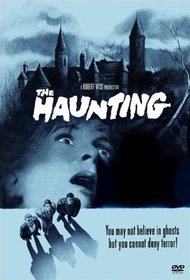
Director Robert Wise's The Haunting begins with both guns blazing, so to speak. As a haunted house film, it starts beautifully--Wise lingers on an eerie black and white shot of Hill House while narration tells us the creepy backstory, which is chock full of death--suicides, probable murders, early intimations that some spiritual force intertwined with the house itself killed people, etc.
From there, we meet Dr. John Markway, an anthropologist, but one who chose anthropology because he felt it was the closest respectable academic discipline to the study of ghosts or "supernatural manifestations." Wise is still full steam ahead at this point, as we learn that Markway intends to lease Hill House for a period of at least a few months and that he intends to invite what he suggests are colleagues (but who turn out to be guinea pigs) to help him in his studies.
The problems begin once we meet the guinea pigs. In particular, as soon as we're introduced to Eleanor Lance. The first two scenes, described in my first two paragraphs, expressed classical horror atmosphere and classical sci-fi brewings in turn -- suggesting a film that would lead to an intriguing mix of the two genres; one that might have resembled "traditional" 1950's sci-fi horror but with Universal eeriness in place of AIP camp. In the scene where we first meet Eleanor, Wise loses his footing and drags out a strange, straight drama, where Eleanor argues about whether she can use her sister's car or not.
That scene wouldn't have to count as a near-fatal blow. At this point, we're still at The Haunting's cover, really, and a torn dustjacket isn't going to ruin the book. As we watch Eleanor drive to Hill House, we discover that the first two pages were torn with the cover, as well. Eleanor narrates her drive by uttering what amounts to inanities; or at least expressing things that we could care less about. She pangs for a house with stone lions guarding the gate, for instance. It's like a pretentious, but very bad, writer thinking they're creating the thinking man's version of a similar, infamous scene from Psycho.
Once Eleanor reaches Hill House, Wise shows signs of recovery. The caretaker is creepy, and his wife is even better. The house in these scenes, while nowhere near as atmospheric as the opening shot, is still intriguing. When Theodora arrives, the sequence is still going strong (thanks in large part to the caretaker's wife).
Unfortunately, from this point, The Haunting falters as frequently as it works. There are many problems, the worst of them a continuation of the narration that we endured while Eleanor took her drive. The temptation may be to blame scripter Nelson Gidding for this, but the blame more strongly lies with novelist Shirley Jackson, whose book "The Haunting of Hill House" was the source of the story. I've only read Jackson's book once, about two years ago, and I have to say that I absolutely hated it. It's content is overflowing with sentences like the one about the stone lions, "cups of stars," etc. as well as ridiculous, but ostensibly serious dialogue. Gidding actually tempers the pretensions of the book as well as he can while still being able to call the film an adaptation. Still, I think the continual narration by Eleanor was a huge mistake, and would have been even if she weren't constantly uttering irritating nonsense. If you watch The Haunting while mentally blocking out the narration, the absence makes every scene otherwise marred by it work exponentially better.
Another problem, in my eyes at least, since when I put on a film with a name and premise like The Haunting, I really want to see a horror film, is that Wise's creation (because this is also true of Jackson's book) more often resides in another genre. This is really a film about relationships and the complex triangle (which at various times becomes a weak quadrangle) between Theodora, Eleanor and Dr. Markway. Theodora is at least a bisexual and has a thing for Eleanor. Eleanor knows this, although she acts oblivious most of the time, and despite her ingrained rejection of homosexuality, seems ambiguously undecided about what she should do (also possibly a factor of the public pretensions of the era). At the same time, she's got the hots for Dr. Markway, who plays knowing but mostly publicly oblivious to her desires, primarily because he's married. Then there's Luke Sanderson, who is more of an aloof playboy type, just as content to hang out, but if one of the women were interested, he'd be game, etc. Despite its superficial trappings, this film is really just a bad soap opera.
When The Haunting does get to those superficial trappings--the "horror" material--it is inert as often as not. Some things work nicely--the banging, the stretching wall and the cold spot. But some things fail as badly as the narration--the evil "lack of right angles" (it really has plenty--did someone misinform the construction crew?), the library stairs and the self-closing doors are examples.
Despite its promising beginning, and its Twilight-Zone-like ending, The Haunting fails because of the lack of focus. Wise and Gidding should have taken the premise, trashed most of Jackson's narrative, and created a quality haunted house film--the good material shows they had it in them. As it stands, if The Haunting is quality horror, Hellraiser is a completely believable, realistic drama.








Couldn't agree less! The
Couldn't agree less! The Haunting is a fine film, probably one of the best ghost movies ever made. Superbly creepy black-and-white cinematography conjure up a sense of menace that is not to be found in many horror movies today...Hopeless review.
I have to agree with the
I have to agree with the previous post as I couldn't agree less as well!!
I simply cannot watch "The Haunting" at night unless I've got company with me and I'm not normally susceptible to the effects of this genre of cinema. Indeed, on telling my Mother once how the film effects me she observed "It must be really good then Peter because you're one of the most practical people I know".
I regard Wise's efforts in this film as up there with Hitchcock at his very best and when Alfred was at his best he was one of the best the cinema industry has ever seem! The shower scene in "Psycho" plus the closing scene in the same film of Anthony Perkins face and narration immediately come to mind! Indeed, Wise seems to use/adapt some of Hitchcock's techniques in "The Haunting" which only goes to prove that "imitation is the sincerest form of flattery".
I think Eleanor's voice-over adds immeasurably to the film and there is no way that I would even try “mentally blocking out the narration” that character does as the film just wouldn't work for me if I did!
"The Haunting" also comprehensively debunks the current Hollywood notion that you need copious amounts of blood, guts and gore to make a good horror film. Apart from a quite 'normal' door handle turning, the odd door or two closing on it's own and some deliciously creepy sound effects, Wise's sole special effects, as we would now think of them, are the panels on a bedroom door bulging in and the spiral staircase in the library seeming to come apart (how both of these were done is ingeniously simply by the way).
This is a top-notch, extraordinarily creepy horror film and I can thoroughly recommend it to any devotee of the genre in particular and good cinema in general!
Peter
Count me in--I disagee with
Count me in--I disagee with this review 100%. This is the only negative review I've ever seen of it...and it's so off the mark it's astounding.
First off Theodora is a lesbian--not bisexual. That's made pretty clear. Second--this is not a bad soap opera. This is about Eleanor and no one else. That's why we get all the narration (some of which is very creepy and just adds to the film). Also you say it's not a horror film????? HUH?????? Did you SEE the film???? I guess the banging, the laughing, Eleanor holding someTHING's hand (that scene always gets me), the "breathing" door, what Eleanor sees at the top of the staircase (when I saw it in a theatre most of the audience screamed) aren't scary? I've seen plenty of horror filsm in my time and this is one of the few that scares me time and time again. I don't know---you seem to have no clue what makes a good horror film. You're probably upset that they didn't show the ghosts too.
I saw this movie in 1963 at
I saw this movie in 1963 at the Circle Theater in Annapolis, Md. ( age 12). Whew, I was scared. I saved it on my DVR, have watched it countless times, and it still scares me. The best horror movie for my money.
This movie still brings back
This movie still brings back memories of lying awake at night listening to every creek in the house... I first watched this movie in my early teens and I didn't sleep for weeks after... scared the living daylights out of me.
Several years later while in my late teens I dared to watch it again and turned it off half way through as it was scaring the life out of me.
Like the previous post, for years I would only watch this with company. At 47 years of age I watched it last year, at night, on a projector when the wife and kids were away... I still felt the shivers down my spine.
I have no idea why this film has such a hold over me. Perhaps its the early memories, certainly no other film has had this effect and I doubt none ever will. My fav Spooky film bar none
Thankfully, this film has
Thankfully, this film has plenty of defenders. If the writer wants a version of "The Haunting" that eliminates Eleanor's interior monologue, and takes the basic premise, but trashes most of Jackson's novel, then he should stick to the re-make directed by Jan deBont - and he's welcome to it! That "re-make" is bloody awful! Robert Wise had a much better grasp of the material.
I totaly have to dis agree
I totaly have to dis agree with the review. The Haunting scared the day lights out of me as a kid. The actions and demeanor of the character Theodora were her psycological predisposition to surrender to the haunting.
I think the review was right
COME HOME ELEANOR COME
COME HOME ELEANOR
COME HOME
Eleanor went home.
It's been over 50 years since I first saw the ovie and I'm still unsure whether to cry or give thanks at the ending. This may be the best movie ever made...
To This Day I Can Remember
To This Day I Can Remember The Experience Of Seeing This Movie For First time When It aired OnTelevision. I Was Ten And Its Still The Most Unnerving experience Of My Youth.
I don't care about any
I don't care about any negative reviews of this film. It works for me and countless others. Robert Wise, his cast and crew created a unique film - a haunted house story that, rather than startle you with actual ghosts, creeps you out the way a so called 'haunted house' would. I think the line spoken by the doctor's wife in the film comes close to the mark: "Now I know who the monster of Hill House is...the interior decorator." Hill House is the creepiest house I would ever NOT want to be in. The camera work, sets and eerie music (the smoke and mirrors of filmmaking, if you will) create an atmosphere of dread that I've never experienced watching any other haunted house film. It's a bona fide classic.
As a latecomer to this
As a latecomer to this discussion, I totally disagree with the reviewer. I thought the film was excellent. I really appreciated the manner in which the film achieved its scarey moments without cheesy and over the top special effects. It puts just enough out there to scare you to death, and it leaves enough for your imagination to take over and do the rest. I thought that the remake did it an injustice. it is truly my favorite horror film.
With a masters in literature,
With a masters in literature, screenwriter with reputable representation, and composing skills. I strongly disagree with the hosts opinion. Shirley Jackson had a unique writers voice. Her use of snytax was inpecable and I use her influence many times when my writing slips into stale verbiage. The thematic premise is an obvious fusion of spirit malelvelance and mental psychological breakdown combined. Her developement of character was extensive. And what can be said for the use of infrared black and white film or set design to create that clausaphobic effect to affect. She was genious.
I disagree with this review
I disagree with this review as well. For my money, this is one of the creepiest haunted house movies ever made. The reason it is SO effective, is that it plays on that age-old "fear of the unknown". What is going on behind the doors and walls is left ENTIRELY to our imaginations, thereby making the suspense nearly unbearable at times. Those who can't, or won't, give it its due must be challenged in the imagination department. It STILL scares the hell out of me if I watch it alone, in a darkened room, in the middle of the night. For people who are attuned to its unique style of psychological horror, it truly is unforgettable.
I find this review to be so
I find this review to be so far off the mark I can't believe the reviewer actually saw the film, except that he recites details enough to where I think he must have.
I first saw The Haunting on TV in the late 1960's when I was a teeanger -- my brother, sister and I watched it along with my mom and it scared the hell out of us. I soon read the underlying novel by Shirley Jackson and I have to say I've never read a scarier story or a better ghost story. It's all about terror -- it's what happens that you can't see that is scary.
When they did the 1999 cheesy remake, I bought a copy of the novel for myself and read it again. At age 47, as I was in 1999, I can tell you that I appreciated Jackson's story more than ever, and I ended up buying a DVD of the 1963 film in black and white. It scared me again. When Eleanor hears the evil voice in the night and a child crying out in fear, and she sees an evil face in the wallpaper pattern on the ceiling, and then feels Theodora sqeezing her hand so tightly -- and then wakes up to find that Theodora is across the room, nowhere near her -- now that was terrifying. So was the experience of being in the room with the four protagonists with a loud, malevolent presence on the other side of that door, trying to get into the room where the people are. My heart was in my throat.
For me, The Haunting, the 1963 version, is the best ghost story and horror film I've ever seen. They did everything exactly right, and the changes they made to Shirley Jackson's original story were cinematically justifiable and minor.
A ghost story without cheesy special effects where the audience never gets to see a single ghost, but where the ghost makes itself known nonetheless, always out of sight, and always malevolent -- it's nothing short of brilliant.
i've watched many many horror
i've watched many many horror films from all eras and i consider Wise's "the Haunting" the best one i've ever seen.